Box breathing, step by step
Settle in
10 secSit upright with your feet on the floor and your shoulders loose. Rest a hand on your belly if it helps you feel the breath.
Breathe out fully
4 secSlowly empty your lungs so you start the first side of the box from empty.
Inhale for 4
4 secBreathe in through your nose for a count of four. Feel your belly and lower ribs expand.
Hold for 4
4 secPause with full lungs for four counts. Keep your throat and jaw relaxed.
Exhale for 4
4 secBreathe out slowly and evenly for four counts.
Hold for 4
4 secPause with empty lungs for four counts, then start the next inhale. That's one round.
Repeat three or four rounds
about 1 minThree or four rounds take about a minute. Keep going longer if it feels good.
What box breathing is
Box breathing (also called square breathing or four-square breathing) gives each part of the breath the same count. You can picture tracing the four sides of a square. Cleveland Clinic describes it as a form of yogic deep breathing, sama vritti pranayama, and notes that the United States Navy SEALs use it.
Because every side is equal, there is nothing to remember except "four." That simplicity is why so many people stick with it. In a Stanford study, people did 5 minutes of breathwork a day for a month. Box breathing was one of three methods compared with mindfulness meditation. Breathwork improved mood more than meditation, and the exhale-focused method (cyclic sighing) stood out most. Box breathing is a good, steady option, not a magic one.
Four equal sides. A pacer keeps them even.
Who it's for
Box breathing is a good fit when you want to feel steady and stay alert: before a presentation, between meetings, or after a stressful message. The holds give your mind something to track, which some people find easier than "just breathe."
If holds make you uncomfortable, try 4-6 breathing or coherent breathing instead. Both have no holds. If you are pregnant or have a heart or lung condition, ask a clinician before practicing breath holds.
Common mistakes
- Straining on the holds. A hold is a pause. If you feel tension building, shorten every side to three counts.
- Breathing high in the chest. Let the belly and lower ribs move. Shoulders should stay down.
- Speeding up. It is easy to drift faster as you go. A pacer or haptic cue keeps the sides even.
- Going too long on day one. Start with three or four rounds. Stop if you feel light-headed.
- Saving it for emergencies. Practicing on calm days makes it easier to reach for when you need it.
How long to practice
Cleveland Clinic suggests three to four rounds, once or twice a day, whatever kind of day you are having. In the Stanford study, participants practiced for 5 minutes daily. A minute or two is enough to start. Add time once the counts feel easy.
The habit matters more than the length of any one session. Anchor it to something daily, like your first coffee or opening your laptop. See how to build a daily breathing habit.
Box breathing with Birch
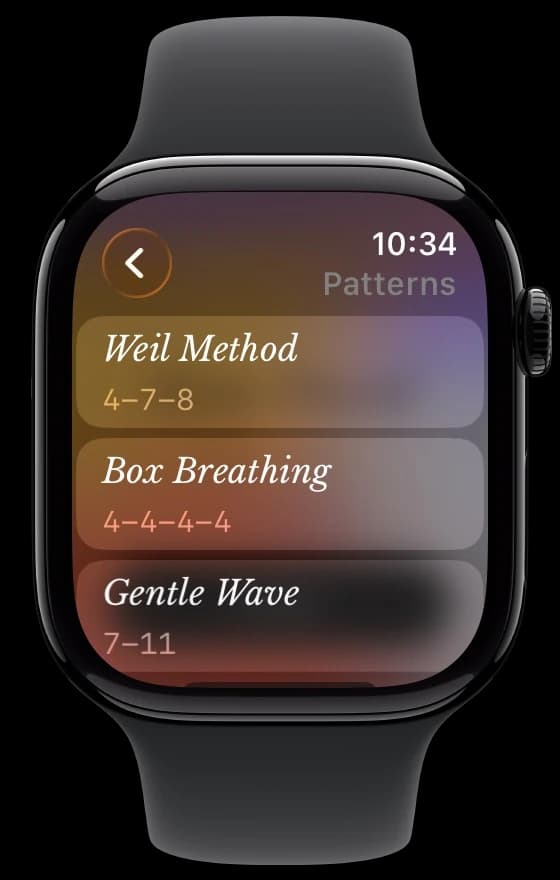
Birch includes Box Breathing 4-4-4-4 on iPhone and Apple Watch. Choose a number of cycles or a time, then follow the guide. On the Watch, a haptic cue marks each side of the box, so you can do a round in a meeting without looking at a screen. Birch is free, with no ads, no account, and no subscription.
Download on theApp Store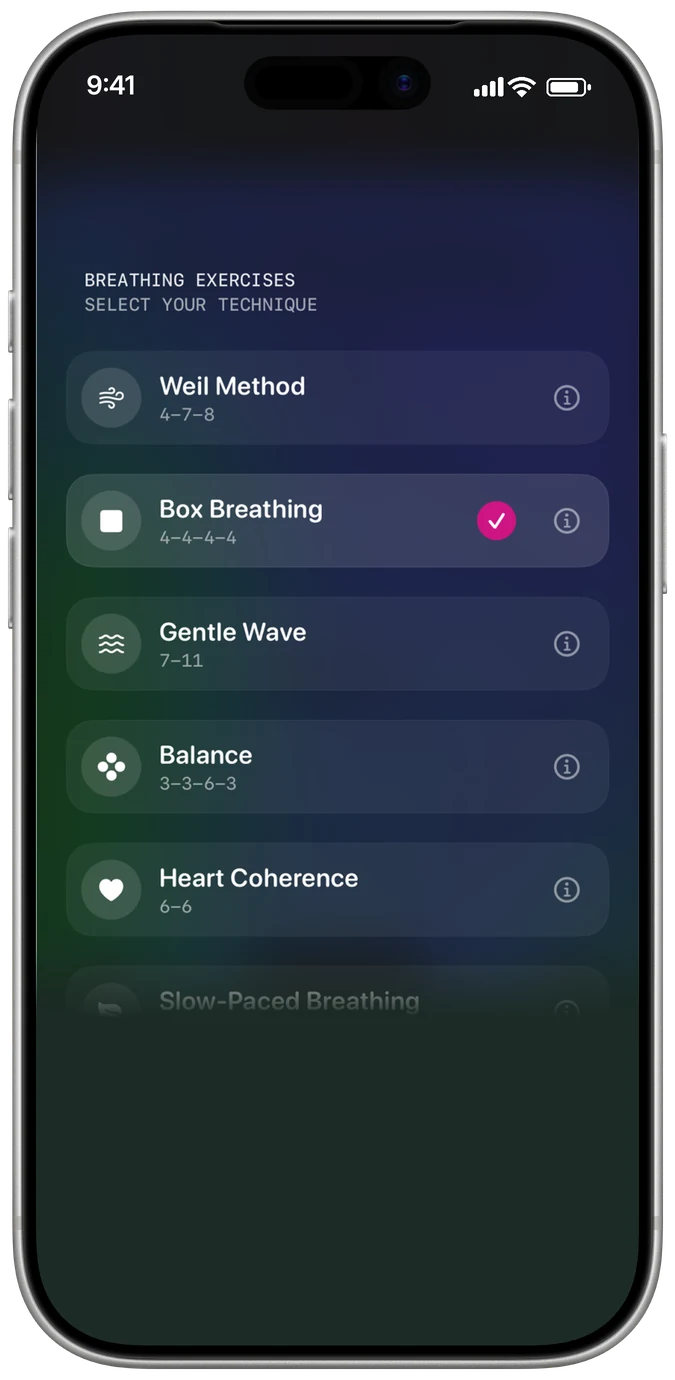
Frequently asked questions
How long should you do box breathing?
Three to four rounds (about a minute), once or twice a day, is Cleveland Clinic's suggestion. Many people build up to about 5 minutes. Short and regular beats long and rare.
What if four seconds is too long?
Use three seconds per side, keep the sides equal, and work up to four as it gets easier.
Is box breathing good for sleep?
It can be part of a wind-down. For bedtime, many people prefer patterns with a longer exhale and no hold at the bottom, such as 4-7-8 or 7-11. See breathing exercises for sleep.
Box breathing vs 4-7-8: which should I use?
Box breathing is even and steady, which suits daytime resets. 4-7-8 has a long exhale and a set four-breath routine, which many people use before sleep. Both are easy to learn.
Can I do box breathing on Apple Watch?
Apple's built-in Breathe session is a simple in-and-out animation without set holds. Birch's free Watch app has a Box Breathing 4-4-4-4 preset with haptic cues for each phase, 1 to 5 minute sessions, and Mindful Minutes in Apple Health. See breathing on Apple Watch.
Is there a free box breathing app?
Yes. Birch is free on the App Store for iPhone and Apple Watch, with no ads, no subscription, no in-app purchases, and no account.
More breathing guides
 Weil MethodHow to do 4-7-8 breathing
 Heart Coherence 6-6How to do coherent breathing
 Apple WatchHow to do breathing exercises on Apple Watch
 Gentle WaveHow to do 7-11 breathing
 Slow-Paced 4-6How to do 4-6 breathing
 BedtimeBreathing exercises for sleep
 Guide · Breathing + habitsHow long should you do breathing exercises?
Breathe along with Birch
Birch paces Box Breathing 4-4-4-4 for you on iPhone, and on Apple Watch with gentle haptic cues, so you can keep your eyes closed. Keep small daily habits beside your breathing. Free, with no ads, no account, and no subscription.
Download on theApp Store
Sources
- Cleveland Clinic — Box Breathing Benefits and Techniques
- Balban et al., 2023. Brief structured respiration practices enhance mood and reduce physiological arousal. Cell Reports Medicine
- Zaccaro et al., 2018. How Breath-Control Can Change Your Life: A Systematic Review on Psycho-Physiological Correlates of Slow Breathing. Frontiers in Human Neuroscience
This guide is for general wellness and education. Birch is not a substitute for professional medical advice. Stop if you feel dizzy or unwell, and talk to a clinician about any health concern.